Friday, December 28, 2012

Just how big of a bitch is karma?


Great question, Karlyn - I'm glad you asked.

I have sat on this query for awhile, not sure how to approach and wanting to be certain whatever I wrote didn't come back to bite me in the ass. Because that's how it works.

We have all heard Sir Isaac Newton's Third Law of Motion: "Every action has an equal and opposite reaction", which is like karma, only scientific. The first two laws of motion deal with velocity and acceleration. There is a little-known "Fourth Law of Motion" that deals with undergarments, but Newton scrapped this law and settled for the aforementioned three when there were some "problems" and subsequent lawsuits (karma) while researching the fourth. He called the omission of the fourth law "streamlining".

There are several versions of the definition of karma sprinkled throughout the Eastern religions, such as Hinduism, Buddhism and Jainism. While these definition have a varying role for "God" in the dispersion of karma, nearly all religions believe that there is a positive or negative aspect to any act set into motion by an individual. And unlike the concept of "fate" where a destiny can be pre-ordained, karma is believed to be generated by the actions of folk with free will to make their choices. In the West, our own Christian beliefs echo the theme of karma as well, with such memorable musings as "one reaps what one sows", "live by the sword, die by the sword" and the ever-popular "what goes around comes around", which has been shouted venomously at adulterers by cuckolds, bankers by those in foreclosure and hairdressers by victims of bad dye-jobs for centuries. Karma.

The measure of the bitch-level of karma would be logically assessed by the "cause and effect" factor. As the ripples in a lake directly correspond to the size of the rock dropped into the water, the retribution of karma - good or bad - should by all the laws of our little world of physics, be directly dispersed in equal measure according to the deed set into motion by an individual.


Artist's rendering of Karmic Equal Measure - otherwise known as Newton's Cradle.
(Initial action on left; karmic reaction on the right)

So, in summary, what goes around comes around in equal measure, if all things are fair, right and scientifically and theologically right in the world. The Karmic Big-Bitch is flexible and can rear her big-bitch muscle as needed in a world full of do-gooders, philanderers, philanthropists and thieves. I'm certain we keep her busy maintaining the world's balance and for that we should offer a hearty "thank you" (and hopefully receive some reciprocal karmic bounty on the back-end). For karma can certainly be a bitch, large or small.

Good day, sir.

Tuesday, December 25, 2012

Why is yawning contagious?


That is a very good question - and thanks for clarifying, Beth. This gives me faith that your daughter is not simply a wisenheimer looking to make things difficult for the crack staff, drivers, floor managers, sous chef and paper-runners of the Just Ask Jerry Scientific Research Lab and Memorial Library. Since we put them through a wild goose chase to answer the same question regarding hiccups, which left them feeling depressed and empty after coming up with a less-than-fulfilling answer, this is our chance to allow them to get back into the swing of things by answering Emelia's true question.

(And what exactly is a wild goose chase? Perhaps another fine question to put the staff through their paces answering. Maybe not the entire staff - perhaps just the runners.)

If I were to hazard a guess as to why the yawn makes us yawn, I would like to think that it has something to do with self-preservation. A yawn is likely caused (as I have no doubt scientific research will verify) by our body struggling to feed itself the vital oxygen needed to live. When our body feels as if it is running a little short on the valuable chemical element "O", it steps on the yawn-pedal, like the carburetor of a classic V-8 automobile. When we see someone else yawn, our own carburetor revs, realizing that someone else is sucking more than their fair share of air, thus depriving our own body/engine of its own much-needed oxygen. So we rev our own motor to make sure we don't get light headed, pass out and bang our head on an end table.

This from Wikipedia: "One study states that yawning occurs when one's blood contains increased amounts of carbon dioxide and therefore becomes in need of the influx of oxygen (or expulsion of carbon dioxide) that a yawn can provide. Yawning may in fact reduce oxygen intake compared to normal respiration. But giving people additional oxygen didn't decrease yawning, and decreasing the amount of carbon dioxide in a subject's environment also didn't prevent yawning."

Well, that shoots down my "O" theory. It has been suggested that yawning helps keep the brain cool, which I am all for. Then there is science...

Also from Wikipedia: "Another hypothesis is that yawns are caused by the same chemicals (neurotransmitters) in the brain that affect emotions, mood, appetite, and other phenomena. These chemicals include serotonin, dopamine, glutamic acid, and nitric oxide. As more (or less) of these compounds are activated in the brain, the frequency of yawning increases. Conversely, a greater presence in the brain of opioid neurotransmitters such as endorphins reduces the frequency of yawning."

See? That was easy.

Now, as to the contagious yawn...

From the World-Wide Web: "Explanations include the idea that yawning may have evolved in early man as a way to signal or set up sleep schedules. A contagious yawn meant that perhaps more than one person was tired and people should sleep accordingly. Since tiredness might indicate a less energetic response to danger, yawning would mean people should find shelter and get out of danger. Those who yawned and paid attention to it may have been selected into the species because they got proper sleep and were more alert to danger."

Apparently, the yawn acts as a sort of reverse-alarm clock. Another theory suggests that the contagious yawn is a sign of empathy, which I also like, since it also helps keep the brain cool. One cannot be too careful when it comes to the brain overheating. So, by all means be empathetic - yawn with others. Your brain will thank you.

Wiki continues: "The proximate cause for contagious yawning may lie with mirror neurons in the frontal cortex of certain vertebrates... Mirror neurons have been proposed as a driving force for imitation which lies at the root of much human learning such as language acquisition. Yawning may be an offshoot of the same imitative impulse."

So, contagious yawning is not only empathetic and useful for maintaining a reasonable brain-temperature, it is also a learning instrument. One thing I am certain of moving forward is that when my boss yawns at work, I will take the opportunity to yawn in response, declare that it is time for some "learning time" and put my cool head down on my desk for a little nap. It's just good science.

Good day, Sir.

Monday, December 24, 2012

Why are hiccups contagious?


Well Emelia, that is a fine and respectable question and I am glad you asked. That said, I have never heard of the hiccup being contagious. I have likewise never witnessed another hiccupping and felt the urge to join in with my own hiccupping cavalcade. I have seen others yawn and leapt right in with my own open-mouthed summons of sleep and watched companions scratch at an itch in the middle of their back and gone of in search of a tree on which to rub the unreachable area between my shoulder blades. A good giggle and sometimes outright sobbing have also proven to be provoked by the similar actions of others.

The hiccup has always been the lone-wolf of the bodily exhalations, put into motion by the unpredictable actions of the diaphragm.

This from the World-Wide Web: Food can be a major cause of spasms in the diaphragm. Some people experience hiccupping fits when they eat too much, as the food presses down on the digestive muscles. Spicy, hot, or cold foods may also irritate the phrenic nerve and cause problems for some people.
Swallowing air seems to cause hiccups in some cases. Eating or drinking too quickly can cause spasms, because swallowed air can exert sudden pressure in the abdomen. Certain foods with large pockets of air, such as sourdough bread, can also cause the diaphragm to contract. Drinking alcoholic, carbonated, or cold beverages is sometimes linked to a greater chance of hiccupping episodes.

At no time does it appear that the hiccup is triggered by the hiccup of another. If yours are proven to be thusly provoked, it is suggested that you give up not only spicy foods, sourdough breads and alcoholic beverages, but also the companionship of those who make you hiccup. They are most likely thoughtless and likely to betray you in the future, with subsequent dire consequences.

Good day, Sir. 

Why do we never see baby pigeons?


Great question, Jeff - thanks for asking.


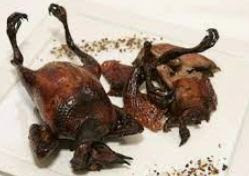
One word: Squab.

Good day, Sir!


Who invented hitchhiking and why did it go away?


That's a good question, Steve and I am delighted you asked. A two-parter - let's break it down. After many hours of extensive and thorough research, I have come to the conclusion that hitchhiking was most likely invented by a man, long ago, in days of yore who was running a bit late. And horseless.

Most likely a wandering troubadour or minstrel, the first hitchhiker was doubtless a carefree gent with little regard for time or obligation. He was probably on the run for stealing fruit at the marketplace or surreptitiously romancing the daughter of an earl. He might have had a fine eye for spotting those with a faulty moral compass, thus making it easy to narrow his search for willing daughters of earls, and to seek the company of other like-minded scoundrels.


Artist's rendering of the likely first hitchhiker. A musician and scoundrel with a faulty moral compass.
 
Hitchhiking remained popular and convenient throughout the centuries, reaching the apex of its popularity during this country's great depression, when most people either lost their cars or drove them til they fell apart, or tramped the rails.
 

A Depression-era family hitching the road in their best finery. While it is tragic to realize that they most likely hadn't eaten for days, it is a bit of a comfort to know that there was a puppy in the suitcase, so it was never necessary to eat the baby.
 
While there is not definite proof, I blame the demise of hitching to the 1986 motion picture "The Hitcher", in which the villainous Rutger Hauer tormented the young C. Thomas Howell. The carefree days of hitchhiking were forever doomed once this movie was stapled into the part of the brain where bad memories live in all would-be hitchers.
 

Thanks, Rutger Hauer, for ruining hitchhiking for everyone.
Good day, Sir.


When did the "wink" become the international symbol for "just kidding"?


Excellent question, Jae - I'm glad you asked, my Apache friend. Let us think about the wink for a moment, before we examine the current use of the delightful twitch in today's world of acronyms, abbreviations, texts and IM's.

I am nearly certain, though I could find nothing in my diligent research to confirm this, that the wink became a method of communication, like hand gestures and the spoken word, by one of two ways: Someone either had an uncontrollable facial tic, or a gnat flew into their eye while in the midst of a conversation. Either way, there must have been a serendipitous connection between what was being said and the wink being construed as an intimate confirmation of the statement. There is also the possibility that the wink may have first arisen in a situation where someone had to blink, but did not trust the person with whom he was conversing enough to close both eyes. I have been in this situation and it is most uncomfortable. Again, however, given the right timing and context, the wink could be useful and the need to blink camouflaged by the conversation altogether.

The meaning of the wink has changed over the ages. For instance, if David Niven winked at you over a martini, he was most likely subtly suggesting that you meet him upstairs in his swanky suite and lose the bloomers somewhere along the way, please. If Paul McCartney winked at you with his chipmunk smile, he was probably being cheeky and disarming you after delivering a pointed verbal barb. And meet him upstairs in his swanky suite and for the love of God, lose the bloomers somewhere along the way, please.

I believe that the wink became the international symbol for "just kidding" about the same time we as human beings began to lose our ability to suss out subtlety and sarcasm in conversation. As we move away from face-to-face interaction, our instinct for person-to-person interpretation is being destroyed by several factors. We look at our telephones or computer monitors and communicate in the cut and dried world of the written word. This leaves very little room for the pauses, inflections and tonal changes that bring life to our language. What we read on any page must be conveyed to reflect our precise meaning through punctuation, word-choice and a somewhat knowledgeable use of phrasing and sentence construction. All other poorly-written or overly-abbreviated communication is open for a wide range of interpretation and this has necessitated the invention of symbols to convey that we have gotten the joke ("LOL") or have even made a joke (;-)). What better symbol to show that we are just kidding than the wink, especially since it's right there on our keyboard, with no more effort than a quick series of key-strokes.

LOL.

Good day, Sir.


Why are there criss-crossed marks on Peanut Butter Cookies?


That's a great question, Steve - I'm glad you asked. I must begin by stating how much I love peanut butter. I could eat peanut butter on toast for breakfast and follow that with a peanut butter sandwich for lunch every day for weeks without complaint. Augment the sandwich with a little bag of Lays Potato Chips (or a big bag if you are a glutton and have no self-control = Guilty) and a cold glass of milk (sometimes with chocolate) and you have a meal for the ages.

That said, I hate peanut butter cookies. I think that they are an abomination and scourge to both the cookie world and the land of peanut butter. I have no idea why these dense little crumbly hockey pucks with their mixed message of peanut butter deliciousness and cookie goodness come out tasting like something that would be fed to incarcerated bestiality felons, but they are simply awful. The answer for those in the know are that the criss-crossed fork marks on the PB cookies are simply a warning to stay the hell away from these harmless-looking treats.


Artist's rendering of what would actually be etched into every Peanut Butter Cookie if cookie-makers had integrity. And something to work with other than a fork.
 
 
According to the World-Wide Web, there are theories that there might be some religious symbolism to the cross on the cookie; which I poo-pooh. There are probably better places to wave one's religious flag than these foul-tasting abhorrences, unless one is trying to scare away potential converts.
 
There is also the line of thinking that the criss-crossed pattern is laid into the cookie dough to keep the dough from crumbling and falling apart. Which would hopefully render the nasty little dry bits of faux-poison inedible, like God intended. Leave it to the cookie makers to defy the ways of nature. This is a plausible explanation, but it leaves the entire cookie-making industry in a horrible light if we are to believe that they have done this on purpose.
 
No, I prefer to think that the peanut butter cookie was created under duress, at the behest of some evil tyrant, or hideous monster or malevolent devil and this was the noble cookie maker's last, subtle attempt to provide us with a warning before consumption.
 
Good day, Sir.