Tuesday, January 31, 2023

What is the Difference Between a Graveyard and a Cemetery?

That is a tremendous question, Tony. While too late to take advantage of Halloween to boost my readership by spooky leaps and bounds, this topic seems well-worth pondering. My immediate thoughts are thus: The graveyard is where spooks, goblins and other nefarious creatures of the night wander in eternal restlessness in search of peace for their tortured souls and ghouls such as Victorian-age graverobbers fulfilled their horrific, filthy deeds.

The cemetery, on the other hand, feels more orderly and much less horrific in my mind. A place where loved ones visit their dearly departed and take comfort in being near and to tend to the gravesite and leave flowers, be they fresh or plastic, which last much, much longer, for those in the memorial know.

My idea of a cemetery

 Of course, I could be wildly wrong. To debunk or confirm my rash and hasty answer to the question, the staff and management of the Go Ask Jerry Research Team, Detective Agency and Haberdashery was dispatched to the four corners of the Earth in search of the truth. And this is what they found:

From the Worldwide Source of Knowledge (Google):

"The word cemetery (from Greek κοιμητήριον, means "sleeping place") implies that the land is specifically designated as a burial ground and originally applied to the Roman catacombs. The term graveyard is often used interchangeably with cemetery, but a graveyard primarily refers to a burial ground within a churchyard."

Aside from the laziness of the over-paid research staff (this lack of effort will be noted in their next merit review...), Everything, it seems, always come back to the Greeks. "Sleeping place" sounds rather kind and mildly soothing for those who have lost a loved-one. Nice move, though it makes little sense to those unwashed masses who have lost touch with the ancient Indo-European languages (me).

Surprisingly, it was the churches who brought the definition of a burial area back to the commonfolk (me). With its easily-deciphered definition, "Grave Yard" leaves little room for error. If you turn up at a graveyard, there should be little to no surprise in what you find upon arrival. Thanks, churches, for once in your holy lives doing something that is not nebulous, haughty and often more than a little creepy. In fact, the use of the word "yard" makes it sound even a little playful, hardly a word often associated with the word "church". 

I stand by my definition of "graveyard", regardless of the researched definition of the term. What better place for the goblins and ghosts to gather to search for relief than in a church graveyard. Where else would a tortured soul go to find its lost way to heaven, I ask you? And as the grave-robbing ghouls would say, "Good day, sir."

Friday, September 23, 2022

What is the difference between a Jungle, a Forest and some Woods?


What a tremendous question, Raymond, and one that desperately needs clarification, for sure!

My first thought is that a jungle is any patch, swath or endless vista of trees and such that is capable of supporting, monkeys, apes, colorful birds and big cats. And their prey. And Tarzan. Also, the availability of edible jungle fruit would be key in identifying a jungle. That and the huge tree-snake wrapping itself around your torso - another clear identifier.

How Tarzan survived in the jungle is a mystery all its own. He lived with apes, yet did not have the ability as a youngster to scurry up a tree or swing from tree to tree to escape tigers, jaguars, pumas, hyenas and the like, which would have made him easy pickings for the big cats. Obviously, once he was big enough to climb and swing and yodel, he was considerably safer, even though he could not grasp a banana with his foot. I'm certain he took a certain amount of ribbing from his ape-brethren for his lack of usable feet, as well as his mostly-hairless body. It didn't seem to affect his self-esteem, because in a matter of just a few years, he was running the show.


A yodeling Tarzan, running the show.

A forest, I assume, would be a smaller grouping of trees, incapable of supporting apes and big cats. Mostly deer, squirrels, rabbits and smaller predatory canines, such as wolves or foxes. Tarzan would also be unlikely to survive in the forest. A young Tarzan, while not needing to the ability to grasp a banana with his feet, would still be easy fodder for the forest-dogs without the aid of his wily monkey friends. Forests would be found abutting farms, castles and other populated communities and could be used to hunt (or poach, if it were owned by gentry) the aforementioned deer, squirrels and rabbits.

Some woods would also be found next to communities, farms and ranches. Sodbusters would hunt for the same game here as in forests and use their lumber to build their rough cabins and later carpentried homes. I would consider the woods to be the younger, red-haired brother of the forest. Much smaller and not much missed if completely destroyed by progress. Just like the younger red-haired brother.

Let's to to the research. This from Sciencing.com: "Woods and forests have no clear delineation in scientific terms, although they are widely considered to be slightly different. Both are expanses of land covered in trees and inhabited by animals, but woods are smaller and their canopy cover significantly less dense than those of forests. Jungles are a colloquially-termed subtype of tropical rainforest that is particularly dense with undergrowth. Woods and deciduous forests are populated by animals such as deer, bears, mice and owls, while jungles are populated by animals such as snakes, monkeys, macaws and crocodiles."

 I forgot about bears. Not to mention crocodiles. Both of which would eagerly devour a young Tarzan. Otherwise, I was pretty much on-point. Good job, Jer-Bear. Take that, research staff.

And as the apes often say, while slinging their feces, "Good day, Sir!"

What are Salad Days?


That is a very good question, George. My first thought is that they are the worst days of the month on the grade-school cafeteria schedule. After all, who in their right mind would look forward to a plate of greens after a week of canned spaghetti, limp frozen cheese pizza, stale-bun hot dogs and fish sticks (or "fish dicks", as we called them with a sixth-grade snicker)?

On a side note, in grade school in the early 1970's, "lunch tickets" were purchased for the week or month and we were issued little punch cards that were diligently punched by hair-netted lunch-ladies as we were processed through the lunch line. Or a kid could pay with cash, had he not had the foresight to pester his parents for a check or cash for the ticket. As hooligans, we would crumple the ticket over and over again until it had the consistency of a dishrag and was probably half its original size. When presented with these abominations, lunch ladies would invariably scowl or scold, depending on their mood. Even if they had gone through the same ritual the day before. We got a great kick out of seeing who could brandish the most distressed lunch card. You can do the same thing with a dollar bill and get the same reaction from your local grocer. Er, I've heard... But I digress.

With the able assistance of the "Just Ask Jerry Research Laboratory, Memorial Library and Family Hayride" staff, I was able to come up with a more appetizing answer to the question "what are salad days?".  According to Wikipedia, the Repository of All Knowledge, and supported by Miriam Webster and Company, the Arbiters of All Things Defined as Words, "Salad Days" are defined as "a youthful time, a period of carefree innocence, idealism and pleasure associated with youth, a heyday, a period when somebody was at the peak of their abilities, not necessarily in their youth."  Such as my life, mid-twenties: pre-AIDS, mid-cocaine, playing music in bars where the women were usually drunk, and if lucky, possessing a  questionable moral compass. Also known as "The Good Old Days".

But why "salad", you may ask. We can thank Bill Shakespeare for the "salad days" turn of phrase, he having apparently grabbed it out of thin air to back the quote in Antony and Cleopatra, where Cleo laments her youthful dalliances with Julius Caesar at the end of Act I "...My salad days, / When I was green in judgment, cold in blood/To say as I said then!  Get it? Green, cold - salad? Leave it to WS, who came up with other phrases we still use to this day, such as "mum's the word", "too much of a good thing" and "dead as a doornail".

One phrase not attributed to Shakespeare: "Good day, sir."

Wednesday, August 10, 2022

 What is "Diddly-Squat?"

Well Michael, that is a tremendous question and one that certainly needed asking, for sure. 

Instinct tells me that since the phrase "diddly-squat" is an insult, the origins of the phrase must have certainly been given the most debasing context possible. "diddly" being almost childlike in its cadence, inferring non-importance by the very sound of its pronunciation . Definitely condescending at the very least. Adding "squat" only further cements the insult, seeming to invoke the position required to go poo-poo. 

This said, it would seem to me that knowing "diddly-squat" is tantamount to "knowing shit", which is insulting and very concise by anyone's standard.

My first thought when told I don't know diddly squat is humiliation. And that my knowledge is limited, if not non-existent. And since my knowledge is limited and possibly compromised altogether, my first guess is likely wrong and should be looked into.

Thanks to the devoted staff of the Jerald Ford Memorial Library, Research Laboratory and Ice Cream Stand, we have been able to dredge up the following from the internet.

Etymology:
The Random House Historical Dictionary of American Slang suggests that this is a variation of doodly-squat from 1934, probably from American slang doodle (“excrement”) + squat, used in the sense of defecating.[1] Doodly-squat was originally the more common form, but diddly-squat overtook it in the early 1980s, and is now an order of magnitude more common in print.

Definition:
slang
: the least amount : anything at alldidn't know diddly-squat about sports— Sam Toperoff
It seems I was closer than my attacker would imagine possible with my guess.So I would have to say, upon further reflection, that he didn't know diddly-squat.
Good day, Sir.

Thursday, August 4, 2022

 How much is a "drove"?

That is a terrific question, Scotty, and one which I have frequently pondered. Usually at 3am, when it is either gnaw on this type of grist or wrestle with the dark demons that try to take over my soul during this, the witching hour. 
But I digress.
This, according to Miriam Webster:
"Drove: A large number of people doing or undergoing the same thing."

This definition smacks of laziness in my humble opinion. Miriam might have had a bad day or simply didn't have the resources to truly investigate - it was, after all, a much simpler time. That said, I would think with today's high-tech gadgetry, technical gewgaws and outer space all at Webster's fingertips, they might have scrubbed this kind of nebulous crowing by now and settled on a more concise, easy-to-follow protocol for defining our language on which the entire universe is inclined to rely.

Don't worry, I'll write them a strongly-worded letter. And it will be concise and easy-to-follow.

While "a large number of people" sounds like a lot, it could mean different things to different people. For instance, for a well-documented introvert like myself, three people in a living room seems like at least one too many and likely two too many. I would define three as "a large number of people" if I were questioned about the event. However, for other more gregarious folk, the more the merrier. God can only imagine what those horn-blowers and cork-poppers might say if you asked them what a large number of people would be - I would guess it would be well into the six-figures. I shudder at the thought.

Horn Blowers and Cork Poppers

Back to the issue of the drove. After reckoning on the problem at least three times longer than the nerds at Miriam Webster, I came up with what I found to be the most logical solution. By using the A1Z26 code system, wherein a letter equals a number (for example, A=1, B=2, and so on), we simply take the word "drove" and apply the code. D=4, R=18, O=15, V=22, E=5.
If you add these numbers up, it equals 67. Which by a Horn-Blower or Cork-Popper's definition would in no way be a large number of people. However, if you line the numbers up together in a row, they show 41,815,225, which by any standard would dictate a large number of people indeed.

So, I can answer, without hesitation that a drove consists of 41,815,225 people. "Droves" would be 83,630,450 or more people. And that my friend, is a lot of cheeseburgers.

Good day, sir.


Friday, July 22, 2022

How Much Wood Could A Woodchuck Chuck...


That is a fantastic question, Kevin - I'm glad you asked. They actually get their name from the Algonquin tribe of Native Americans, who originally called them “wuchak.”  English settlers, in trying to use that word, likely came up with the name “woodchuck.”  Depending on where you are in the country, woodchucks are also known as groundhogs, land beavers, and whistling pigs. This from the Wikipedia.
Personally, I prefer the "whistling pig" moniker, even though the rodent is not related to the porcine species in any way. Nor does it whistle. It just sounds more fun than groundhog or woodchuck. Land beaver just sounds like a weekend goal for a twenty-three year-old fella.
But I digress. About the chucking, one must first examine the ability of the animal to chuck. Since the name attributed to the land beaver (tee-hee) is based on it's Native American sobriquet, we can assume it had nothing to do with the animal's ability to hurl wood, or any other object for that matter. And the composition of its body does not lend itself to easy-chucking, with its short, stumpy arms and tiny paws. Unless the whistling pig is inclined to sling a branch using its jaws to grip the stick and its powerful, thick neck to propel it, the chances of it successfully tossing wood are very slim indeed.

That said, I believe that if a woodchuck could chuck wood, I imagine it would be quite a bit, given the animal's boundless energy and tenaciousness. 

If it only had thumbs and some longer arms. God is cruel.

Answer: two to three pounds of wood per hour.

Good day, sir.

Friday, January 25, 2013

What is the difference between tennis shoes and sneakers?


Ken, that is a fantastic question and I am delighted you asked. If I were to hazard a guess, I would say that tennis shoes are sold mainly for use on the tennis courts and probably have some kind of tricky, scientific design specifics that make them more suitable for the abrupt changes of direction and lateral movement inherent in the game that might blow other shoes out like a second-hand, high-mileage retread.

Sneakers, on the other hand, are most likely a rubber-soled shoe that would be worn by athletes and spies alike, who either need excellent traction or stealthy silence in their movement - hence the term "sneakers". I would also offer that the term "gumshoe" for the private eye probably came about from the requirement of stealth in the business of sleuthing. Whether or not a "gumshoe" is the same as "sneaker", I have no idea. I would also assert that a tennis shoe can be a sneaker, but a sneaker is not necessarily a tennis shoe. Let's go to the web...

"Sneakers go back a long way. In the late 18th century, people wore rubber soled shoes called plimsolls, but they were pretty crude—for one thing, there was no right foot or left foot. Around 1892, the U.S. Rubber Company came up with more comfortable rubber sneakers with canvas tops, called Keds. By 1917, these sneakers began to be mass produced. (They got the nickname sneakers because they were so quiet, a person wearing them could sneak up on someone.)" Ta-da, this from factmaster.com. I like the idea of the plimsoll - trying to differentiate between the left and right foot in the dark (especially scampering out a window with a jealous husband in hot-pursuit - just saying) can be trying. Plus, I think the plimsoll would make an excellent slapshoe, should one have the urge to be a circus clown or a silent film comedian.

And this from answers.com, regarding the gumshoe:

Gumshoe
(gŭm'shū') pronunciation
n.
  1. A sneaker or rubber overshoe.
  2. Slang. An investigator, especially a detective.


I hope this answers your question - if it doesn't, feel free to hire a gumshoe to get to the bottom of it.

Good day, Sir.


Thursday, January 24, 2013

"Pop" versus "Soda" - WTF?


This is a fantastic question, John and I am delighted you asked. I believe your initial inquiry was where and when this arbitrary diversion of terms for our beloved carbonated beverages originated and we will explore that as well. But I believe that it is equally, if not more important to Divine "what the fuck?".

My early childhood days were spent in Northern Ohio, near the banks of the Lake of Erie. If we went into a corner store or tavern or diner, my parents would order we children a "pop" - the local term for the caramel-colored variety of fizzy-drink, be it Coca-Cola, Pepsi or the regional favorite Royal Crown. This was most likely derived from the term "Soda Pop", which in turn must have gleaned its own moniker from the sound that was made when the spigots of the soda fountains from which they were drawn were opened, or the sound the bottle caps made when removed from the carbonated bottles. If we were having a clear soft drink, it was referred to as a "7-Up". This strange intermingling of the generic term "pop" and the brand name "7-Up" was a harbinger of soda things to come.
Sound confusing? Just wait.

When I moved to Arizona, later on in my childhood, I found that "pop" was called "soda". "Coke", of course was Coca Cola, or one could order a Pepsi. RC was left behind in the cloud of dust that made up the trail between Akron and Phoenix. I learned even later on that many folks (mostly in the South) referred to pop as "Coke", regardless of whether or not it was Coca Cola or one of its soda-pop competitors that was being poured.Visiting relatives in North Carolina, I was mildly confused when one of my cousins ordered a "Coke" and was given a Pepsi Cola. I pointed this out and she looked at me as if I had a third eye. An eye that obviously did not know its soda pop.

This is part of the fabric that has been woven the often-confused, distracted tapestry of my life and it's no wonder.

Enough of the "What the fuck". Let's get down to the "where and when the fuck". If you notice the map above, there is a clear line of delineation where the Northern "pop"-people and the Southern "Coke" -folk divide and I will attempt to make good, sound logical sense of the matter.

The soda fountain made its first appearance in 1819, a good 40 years before the Civil War. The first bottled fizzy was in 1835 and the term "pop" was coined in 1861, the year the Great War got underway.
It is my opinion that the entire geographical country referred to the soft drink as "soda pop" - at least for awhile. With the outbreak of the war, the North probably took claim to the "pop" portion of the name as an act of war and ran with it, while the Southerners either dismissed the term altogether in a definitive act of soft drink-defiance or the Northern blockade effectively removed the soft drink from the diet of the Southron altogether, thus nullifying the need for any descriptive whatsoever.

After the war, the Northerners most likely continued their smug use of the term "pop" - it was light, gay and carefree; they were winners. The people of the South, meanwhile, still smarting from their recent defeat, languished in reconstruction and probably threw their Johnny Reb caps in the air with the advent of Coca Cola in 1886, which actually contained the drug cocaine. The drink "was initially sold as a patent medicine for five cents a glass at soda fountains, which were popular in the United States at the time due to the belief that carbonated water was good for the health. It was claimed Coca-Cola cured many diseases, including morphine addiction, dyspepsia, neurasthenia, headache, and impotence." This according to Wikipedia.

Dulled by their dependance on the drink and the drug within, the Southern imbibers were undoubtedly dissatisfied with the non-narcotic soft drinks available and took to calling all soda "COKE", in a desparate attempt to get their hands on the miracle narcotic drink. Years of repetition and empty hope inevitably scorched this ideal into their brains, even long after the actual cocaine had been removed from the recipe.

The term "Soda" was pilfered shortly thereafter by the new kids on the block, the irreverant West, and is a keen example of their forward thinking, land-grabbing attitudes and innate sense of Western, land-grabbing entitlement. By claiming the lead word in the term "Soda Pop", the eternal optimism and free-wheeling nature of a land graced by God with endless sunshine and clear blue seas dug its tanned, muscular elbow into the rest of the war-ravaged nation. With their suddenly outdated "Pop" and "Coke", the North and South and even the Eastern seaboard were looked upon as uneducated, un-hip second-citizens of soda.

And so it remains.

Good day, Sir.

Tuesday, January 15, 2013

Where's Waldo?


That's a fantastic question, John and I'm happy you asked. I remember this character and the ageless question "Where's Waldo" from when my kids were actually kids. But let's get one thing straight - I don't find Waldo or trying to track him down in the least bit cute. I have never trusted this Waldo fellow and looking into his whereabouts only makes him seem even more shady than I had originally thought. I question his wardrobe, his eyeware and the creepy smile on his self-satisfied mug. I have no doubt that he has come to a bad end. Most likely at the business end of a gay biker bar in a quest to satisfy his seemingly endless hunger for the rough trade. That's pure speculation on my part, of course, based on my own close-minded attitude about striped shirts, stocking caps with tassles and walking sticks carried by youth. For all I know, Waldo could be a lifeguard at Coney Island in one of those old-timey striped one-piece bathing suits, or perhaps serving hard time on a Southern prison chain gang after knifing a drifter, or because his deviant, rough-trade lifestyle is not the least bit appreciated.

Or, perhaps Waldo has made his getaway from the Southern chain gang and finagled his way to the Far-East, where he will no doubt meet a bitter end at the hands of a sadistic Vietnamese prison guard or be hauled before international court of law, like Gary Glitter and brought home to face the music.

Wherever home is - but then, that has always been the question, hasn't it?

I'll bet that wherever Waldo hangs his betassled hat, there are drifters and rough-trade merchants aplenty.

Good day, Sir.
 

Friday, January 11, 2013

What is a gift horse and why on Earth shouldn't we look it in the mouth?

Why, Jerry, that's a great question and thanks for asking. Yes, I indeed asked this question of myself this morning after using the phrase "I don't want to look a gift horse in the mouth" in a sentence today. I think I figured this one out on my own in short order, but there may be those out there who are not familiar with the nefarious ways of the horse-trader. While science,  savvy veterinarians and the Internet may have forced the horse-trader and his ilk to straighten up and fly right over the years, there is still something shifty that seems to taint the air around those in the business. I am nearly certain they prefer to be known as horse-merchants or equine distributors or some such like-term that puts much-needed distance between themselves as respectable business-people and the horse traders of the wild west, where this old saw probably reached the apex of its popularity.

In the days when the horse was the primary means of transportation, the horse trader was the equivalent of today's used-car salesman and not above misrepresenting his product in an attempt to pry an extra hard-earned shekel out of the pockets of his prospective clients. This would sometimes result in the unsavory trader being shot, stabbed or lynched by disgruntled customers. It was the way of the west and an occupational hazard.


Unsavory horse traders were sometimes shot, stabbed or lynched by disgruntled customers.

One of the means by which the shady trader would try to bamboozle his clients would be by lying about a horse's age. This little fib might lead one to believe that a horse had suffered many less miles afoot and therefore be much heartier and robust. One way to check the trader's claim would be by examining the horse's teeth, which would show wear and tear and gum damage and other red flags apparent to those in the know on such matters. This little fib might also lead to the trader being shot, stabbed or lynched. It was the old-west version of the modern-day "kicking the tires", only with the possibility of gunplay.

So, if one were so lucky as to receive a horse as a gift (the "gift horse"), it would seem unappreciative to examine the beast's teeth in front of the gift-giver. I am not certain, but I imagine seeming unappreciative upon receiving a gift horse might also lead to the eventual shooting, stabbing or lynching of an unappreciative son of a bitch.

In other words, appreciate your gifts - it's never too late for a necktie party for the unscrupulous or unappreciative.

Good day, sir.

Wednesday, January 9, 2013

How and when did Buffalo Wings Inflitrate our pizza parlors?


That's a fantastic question, Mark, and I'm happy you asked. The "Pizza Parlor Conundrum" aside, I would at the outset like to take a moment to discuss the tasty treat that is the chicken wing. First off, it took me a long time to dive into the chicken-wing pool. This was because I was horrified to think of all the little genetically-engineered midget-chickens that were being held in a midget-chicken gulag someplace in Minnesota, awaiting their turn at the chopping block. After all, how else could chicken-science have ever possibly come up with something as perfect as the little drummette that made up the meaty portion of the plate? It had to be mini-chickens and I imagined them to be the veal of the dark-meat side of the chicken-world, chained up in little mini-chicken coops, eating bits of a scientifically-manufactured super-grain to fatten up their tiny chicken drummettes. Or maybe the drummettes were taken from the feckless Cornish Hen, which I always considered to be the fragile and meek "little people" of the chicken world. I didn't know and I didn't care - all I knew was that it was horrific and it was more than my young, fragile, compassionate mind could handle.


The mysterious makeup of the chicken wing: The Wingette and the Drummette
 

Eventually, however, the allure of the tangy, spicy sauce inevitably trumped my indignant horror over the mistreatment of the genetically-engineered mini-chickens or Cornish Hens and I dipped my first drummette into the ramekin of bleu-cheese dressing and savored the deliciousness of the dish. It was only much later that I learned that the drummette, of which I was particularly fond, was not harvested from the carcass of midget-chickens, or the Cornish Hen but was actually the meaty part of the wing closest to the full-sized chicken's body and it hinged on the flimsier, two-boned portion of the wing which has always proven to be more problematic and messy when under consumption. Since the full-sized chickens have always been butchered en-masse to appease the planet's taste for fowl, I no longer felt any particular sadness or guilt when it came to the wing. I was now free to dive in, fingers-first with a new-found abandon which somehow liberated me in a tasty way to enjoy the magnificent appetizer.

All that said, there is a reason for my digression and many thanks for hanging in there. It is my belief that it is not necessarily the wings that have infiltrated our pizza parlors, but rather the tangy, zesty sauce which has been concocted for their deep-fried tossing. A combination of hot-sauce, vinegar (or Italian dressing) and butter, it is the perfect storm of taste-sensation and the ideal candidate for infiltrating not only our pizza parlors, but every sector of dining imaginable. I challenge you to find a food-choice that has not been touched by the red-stained finger of wing-sauce. Aside from breakfast cereal and ice cream (and just wait, it will soon be there as well), I am hard-pressed to find an example. Buffalo Chicken Salad, Buffalo Chicken Sandwich, Buffalo Chicken Fingers and sides of Buffalo Sauce are readily available in nearly every eatery in the country - nay, the world. And I am not entirely convinced that this is a bad thing.

As for the days of yore, when one could stroll into a pizza parlor and order a thin-crust pepperoni and an ice cold glass of draft beer and little else, I believe those times have gone the way of silent film, the Polaroid Land Camera and the rotary telephone. If a restaurant - be it a pizza parlor or a take out Chinese joint - is not diverse in its offering, the spoiled, entitled, self-absorbed restaurant diners that make up our populace will move to the next bistro that will be able to satisfy their culinary wanderlust. We have become a nation of instant-gratification junkies and this applies to our taste in food as equally as it applies to our need for music, movies and information on the fly. That, my friend, is how Buffalo Wings infiltrated our pizza parlors. As to the exact when, I point to the moment that Teressa Bellissimo, owner of the Anchor Bar in Buffalo, New York created the sauce to toss her deep-fried chicken castoffs into back in 1964. From that moment forward, it was only a matter of time before the recipe would snake its insidious way into our restaurants and our hearts.

Good day, Sir.

Friday, December 28, 2012

Just how big of a bitch is karma?


Great question, Karlyn - I'm glad you asked.

I have sat on this query for awhile, not sure how to approach and wanting to be certain whatever I wrote didn't come back to bite me in the ass. Because that's how it works.

We have all heard Sir Isaac Newton's Third Law of Motion: "Every action has an equal and opposite reaction", which is like karma, only scientific. The first two laws of motion deal with velocity and acceleration. There is a little-known "Fourth Law of Motion" that deals with undergarments, but Newton scrapped this law and settled for the aforementioned three when there were some "problems" and subsequent lawsuits (karma) while researching the fourth. He called the omission of the fourth law "streamlining".

There are several versions of the definition of karma sprinkled throughout the Eastern religions, such as Hinduism, Buddhism and Jainism. While these definition have a varying role for "God" in the dispersion of karma, nearly all religions believe that there is a positive or negative aspect to any act set into motion by an individual. And unlike the concept of "fate" where a destiny can be pre-ordained, karma is believed to be generated by the actions of folk with free will to make their choices. In the West, our own Christian beliefs echo the theme of karma as well, with such memorable musings as "one reaps what one sows", "live by the sword, die by the sword" and the ever-popular "what goes around comes around", which has been shouted venomously at adulterers by cuckolds, bankers by those in foreclosure and hairdressers by victims of bad dye-jobs for centuries. Karma.

The measure of the bitch-level of karma would be logically assessed by the "cause and effect" factor. As the ripples in a lake directly correspond to the size of the rock dropped into the water, the retribution of karma - good or bad - should by all the laws of our little world of physics, be directly dispersed in equal measure according to the deed set into motion by an individual.


Artist's rendering of Karmic Equal Measure - otherwise known as Newton's Cradle.
(Initial action on left; karmic reaction on the right)

So, in summary, what goes around comes around in equal measure, if all things are fair, right and scientifically and theologically right in the world. The Karmic Big-Bitch is flexible and can rear her big-bitch muscle as needed in a world full of do-gooders, philanderers, philanthropists and thieves. I'm certain we keep her busy maintaining the world's balance and for that we should offer a hearty "thank you" (and hopefully receive some reciprocal karmic bounty on the back-end). For karma can certainly be a bitch, large or small.

Good day, sir.

Tuesday, December 25, 2012

Why is yawning contagious?


That is a very good question - and thanks for clarifying, Beth. This gives me faith that your daughter is not simply a wisenheimer looking to make things difficult for the crack staff, drivers, floor managers, sous chef and paper-runners of the Just Ask Jerry Scientific Research Lab and Memorial Library. Since we put them through a wild goose chase to answer the same question regarding hiccups, which left them feeling depressed and empty after coming up with a less-than-fulfilling answer, this is our chance to allow them to get back into the swing of things by answering Emelia's true question.

(And what exactly is a wild goose chase? Perhaps another fine question to put the staff through their paces answering. Maybe not the entire staff - perhaps just the runners.)

If I were to hazard a guess as to why the yawn makes us yawn, I would like to think that it has something to do with self-preservation. A yawn is likely caused (as I have no doubt scientific research will verify) by our body struggling to feed itself the vital oxygen needed to live. When our body feels as if it is running a little short on the valuable chemical element "O", it steps on the yawn-pedal, like the carburetor of a classic V-8 automobile. When we see someone else yawn, our own carburetor revs, realizing that someone else is sucking more than their fair share of air, thus depriving our own body/engine of its own much-needed oxygen. So we rev our own motor to make sure we don't get light headed, pass out and bang our head on an end table.

This from Wikipedia: "One study states that yawning occurs when one's blood contains increased amounts of carbon dioxide and therefore becomes in need of the influx of oxygen (or expulsion of carbon dioxide) that a yawn can provide. Yawning may in fact reduce oxygen intake compared to normal respiration. But giving people additional oxygen didn't decrease yawning, and decreasing the amount of carbon dioxide in a subject's environment also didn't prevent yawning."

Well, that shoots down my "O" theory. It has been suggested that yawning helps keep the brain cool, which I am all for. Then there is science...

Also from Wikipedia: "Another hypothesis is that yawns are caused by the same chemicals (neurotransmitters) in the brain that affect emotions, mood, appetite, and other phenomena. These chemicals include serotonin, dopamine, glutamic acid, and nitric oxide. As more (or less) of these compounds are activated in the brain, the frequency of yawning increases. Conversely, a greater presence in the brain of opioid neurotransmitters such as endorphins reduces the frequency of yawning."

See? That was easy.

Now, as to the contagious yawn...

From the World-Wide Web: "Explanations include the idea that yawning may have evolved in early man as a way to signal or set up sleep schedules. A contagious yawn meant that perhaps more than one person was tired and people should sleep accordingly. Since tiredness might indicate a less energetic response to danger, yawning would mean people should find shelter and get out of danger. Those who yawned and paid attention to it may have been selected into the species because they got proper sleep and were more alert to danger."

Apparently, the yawn acts as a sort of reverse-alarm clock. Another theory suggests that the contagious yawn is a sign of empathy, which I also like, since it also helps keep the brain cool. One cannot be too careful when it comes to the brain overheating. So, by all means be empathetic - yawn with others. Your brain will thank you.

Wiki continues: "The proximate cause for contagious yawning may lie with mirror neurons in the frontal cortex of certain vertebrates... Mirror neurons have been proposed as a driving force for imitation which lies at the root of much human learning such as language acquisition. Yawning may be an offshoot of the same imitative impulse."

So, contagious yawning is not only empathetic and useful for maintaining a reasonable brain-temperature, it is also a learning instrument. One thing I am certain of moving forward is that when my boss yawns at work, I will take the opportunity to yawn in response, declare that it is time for some "learning time" and put my cool head down on my desk for a little nap. It's just good science.

Good day, Sir.

Monday, December 24, 2012

Why are hiccups contagious?


Well Emelia, that is a fine and respectable question and I am glad you asked. That said, I have never heard of the hiccup being contagious. I have likewise never witnessed another hiccupping and felt the urge to join in with my own hiccupping cavalcade. I have seen others yawn and leapt right in with my own open-mouthed summons of sleep and watched companions scratch at an itch in the middle of their back and gone of in search of a tree on which to rub the unreachable area between my shoulder blades. A good giggle and sometimes outright sobbing have also proven to be provoked by the similar actions of others.

The hiccup has always been the lone-wolf of the bodily exhalations, put into motion by the unpredictable actions of the diaphragm.

This from the World-Wide Web: Food can be a major cause of spasms in the diaphragm. Some people experience hiccupping fits when they eat too much, as the food presses down on the digestive muscles. Spicy, hot, or cold foods may also irritate the phrenic nerve and cause problems for some people.
Swallowing air seems to cause hiccups in some cases. Eating or drinking too quickly can cause spasms, because swallowed air can exert sudden pressure in the abdomen. Certain foods with large pockets of air, such as sourdough bread, can also cause the diaphragm to contract. Drinking alcoholic, carbonated, or cold beverages is sometimes linked to a greater chance of hiccupping episodes.

At no time does it appear that the hiccup is triggered by the hiccup of another. If yours are proven to be thusly provoked, it is suggested that you give up not only spicy foods, sourdough breads and alcoholic beverages, but also the companionship of those who make you hiccup. They are most likely thoughtless and likely to betray you in the future, with subsequent dire consequences.

Good day, Sir. 
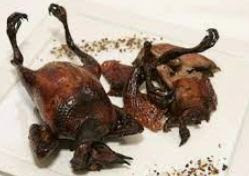
Why do we never see baby pigeons?


Great question, Jeff - thanks for asking.


One word: Squab.

Good day, Sir!


Who invented hitchhiking and why did it go away?


That's a good question, Steve and I am delighted you asked. A two-parter - let's break it down. After many hours of extensive and thorough research, I have come to the conclusion that hitchhiking was most likely invented by a man, long ago, in days of yore who was running a bit late. And horseless.

Most likely a wandering troubadour or minstrel, the first hitchhiker was doubtless a carefree gent with little regard for time or obligation. He was probably on the run for stealing fruit at the marketplace or surreptitiously romancing the daughter of an earl. He might have had a fine eye for spotting those with a faulty moral compass, thus making it easy to narrow his search for willing daughters of earls, and to seek the company of other like-minded scoundrels.


Artist's rendering of the likely first hitchhiker. A musician and scoundrel with a faulty moral compass.
 
Hitchhiking remained popular and convenient throughout the centuries, reaching the apex of its popularity during this country's great depression, when most people either lost their cars or drove them til they fell apart, or tramped the rails.
 

A Depression-era family hitching the road in their best finery. While it is tragic to realize that they most likely hadn't eaten for days, it is a bit of a comfort to know that there was a puppy in the suitcase, so it was never necessary to eat the baby.
 
While there is not definite proof, I blame the demise of hitching to the 1986 motion picture "The Hitcher", in which the villainous Rutger Hauer tormented the young C. Thomas Howell. The carefree days of hitchhiking were forever doomed once this movie was stapled into the part of the brain where bad memories live in all would-be hitchers.
 

Thanks, Rutger Hauer, for ruining hitchhiking for everyone.
Good day, Sir.


When did the "wink" become the international symbol for "just kidding"?


Excellent question, Jae - I'm glad you asked, my Apache friend. Let us think about the wink for a moment, before we examine the current use of the delightful twitch in today's world of acronyms, abbreviations, texts and IM's.

I am nearly certain, though I could find nothing in my diligent research to confirm this, that the wink became a method of communication, like hand gestures and the spoken word, by one of two ways: Someone either had an uncontrollable facial tic, or a gnat flew into their eye while in the midst of a conversation. Either way, there must have been a serendipitous connection between what was being said and the wink being construed as an intimate confirmation of the statement. There is also the possibility that the wink may have first arisen in a situation where someone had to blink, but did not trust the person with whom he was conversing enough to close both eyes. I have been in this situation and it is most uncomfortable. Again, however, given the right timing and context, the wink could be useful and the need to blink camouflaged by the conversation altogether.

The meaning of the wink has changed over the ages. For instance, if David Niven winked at you over a martini, he was most likely subtly suggesting that you meet him upstairs in his swanky suite and lose the bloomers somewhere along the way, please. If Paul McCartney winked at you with his chipmunk smile, he was probably being cheeky and disarming you after delivering a pointed verbal barb. And meet him upstairs in his swanky suite and for the love of God, lose the bloomers somewhere along the way, please.

I believe that the wink became the international symbol for "just kidding" about the same time we as human beings began to lose our ability to suss out subtlety and sarcasm in conversation. As we move away from face-to-face interaction, our instinct for person-to-person interpretation is being destroyed by several factors. We look at our telephones or computer monitors and communicate in the cut and dried world of the written word. This leaves very little room for the pauses, inflections and tonal changes that bring life to our language. What we read on any page must be conveyed to reflect our precise meaning through punctuation, word-choice and a somewhat knowledgeable use of phrasing and sentence construction. All other poorly-written or overly-abbreviated communication is open for a wide range of interpretation and this has necessitated the invention of symbols to convey that we have gotten the joke ("LOL") or have even made a joke (;-)). What better symbol to show that we are just kidding than the wink, especially since it's right there on our keyboard, with no more effort than a quick series of key-strokes.

LOL.

Good day, Sir.


Why are there criss-crossed marks on Peanut Butter Cookies?


That's a great question, Steve - I'm glad you asked. I must begin by stating how much I love peanut butter. I could eat peanut butter on toast for breakfast and follow that with a peanut butter sandwich for lunch every day for weeks without complaint. Augment the sandwich with a little bag of Lays Potato Chips (or a big bag if you are a glutton and have no self-control = Guilty) and a cold glass of milk (sometimes with chocolate) and you have a meal for the ages.

That said, I hate peanut butter cookies. I think that they are an abomination and scourge to both the cookie world and the land of peanut butter. I have no idea why these dense little crumbly hockey pucks with their mixed message of peanut butter deliciousness and cookie goodness come out tasting like something that would be fed to incarcerated bestiality felons, but they are simply awful. The answer for those in the know are that the criss-crossed fork marks on the PB cookies are simply a warning to stay the hell away from these harmless-looking treats.


Artist's rendering of what would actually be etched into every Peanut Butter Cookie if cookie-makers had integrity. And something to work with other than a fork.
 
 
According to the World-Wide Web, there are theories that there might be some religious symbolism to the cross on the cookie; which I poo-pooh. There are probably better places to wave one's religious flag than these foul-tasting abhorrences, unless one is trying to scare away potential converts.
 
There is also the line of thinking that the criss-crossed pattern is laid into the cookie dough to keep the dough from crumbling and falling apart. Which would hopefully render the nasty little dry bits of faux-poison inedible, like God intended. Leave it to the cookie makers to defy the ways of nature. This is a plausible explanation, but it leaves the entire cookie-making industry in a horrible light if we are to believe that they have done this on purpose.
 
No, I prefer to think that the peanut butter cookie was created under duress, at the behest of some evil tyrant, or hideous monster or malevolent devil and this was the noble cookie maker's last, subtle attempt to provide us with a warning before consumption.
 
Good day, Sir.